Tuesday, July 26, 2011

Improving the Extension Program Planning Process?

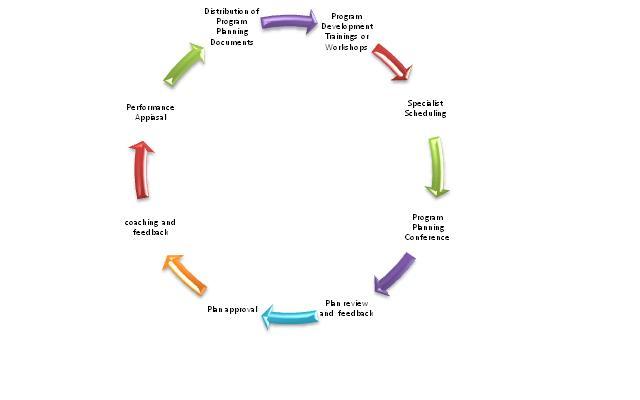
Texas AgriLife Extension Service places a great deal of time and resources in conducting program planning conferences.  It is no doubt that program planning conferences is a critical component of Texas Agrilife Extension Service’s performance management system.  However, the program planning conference itself is only one component in a  series of related activities which includes the distribution of Program Planning documents that provides expectations for programming, Program Development Trainings and Workshops, Specialist Scheduling,  the Program Planning Conference, Plan review and feedback, Plan approval, coaching and feedback by District Extension Administrator and Regional Program Directors during the implementation of programs, and the Performance Appraisal.  The following graph illustrates Texas AgriLife Extension Service’s performance management system;
In today’s economic climate program planning must be focused on ensuring that Extension is efficiently allocating resources that results in the following;
  • Program excellence not just focused on approving a plan on the TeXas System.
  • Committed to developing better programs that result in measurable outcomes.
  • More efficient utilization of District Extension Administrator, Regional Program Directors and Agents time.
One of the methods that will be utilized to increase the efficiency of the program planning conference will be utilizing Lync to conduct the program planning conference.   We will utilize this distance educational communication tool to add value to pre- program  planning conference activities (distribution of program planning materials, program development trainings or workshops, specialist scheduling, etc.) by employing video conferencing capabilities that is collaborative, engaging, and cost effective.

Microsoft Lync can provide the following benefits for Extension;
  • Control costs – District Extension Administrator, Regional Program Directors and agents can effectively communicate among geographically dispersed County and District offices without long distance charges. Integrated audio, video, and Web conferencing will reduce travel costs, as well as the cost of third-party teleconferencing fees.
  • Improve productivity- Applications available with Lync assists District Extension Administrator, Regional Program Directors and Agents communicate within a more productive format. Instead of e-mailing documents back and forth for approval, Middle Managers and Agents can rely on real-time collaboration through desktop applications such as sharing plans and reports on the TeXas System, power point presentations, Word documents and utilization of  a virtual whiteboard.
  • Gain operational efficiencies -By integrating Lync  in program planing and conferencing  delays can be reduced or eliminated. For geographically dispersed county and district offices, group chat can enable efficient, topic-specific, multi-party discussions saving time and money.
  • Enables Extension to be more responsive to clientele- By reducing the number of face to face meetings that require travel time for Agents allowing them to be in the county to respond to clientele needs and conduct educational programming.
Whenever any change is implemented some are reluctant and have questions related to the change. The following are some questions that have been posed related to the use of distance education in program planning conferences;

Question- Will Lync be utilized for conferences with all agents?
Answer- All agents may be involved with a Lync conference, but agents who need additional assistance will be required to attended a face to face program planning session.  The District Extension Administrator and Regional Program Directors will identify those agents who need to participate in a scheduled face to face session which include agents who are not prepared for their Lync session, new agents, agents who have plans that do not contain required elements, agents who have performance issues, etc.

Question- What happens if the system does not work the day the Lync session is scheduled?
Answer-This system has proven to be very reliable, however it is always advisable to have backup plans in the event a technical problem arises.  However, this is really no different than if an agent or middle manager has car trouble on their way to a meeting– we need to have a backup plan to accommodate unexpected situations!

Question- Will this diminish the effectiveness of the program planning conference?
Answer- No! The program planning conference is only one component of the performance management system and if we conduct quality program development trainings or workshops and conduct an effective program planning conference via Lync our program planning should be even more effective.  It should be emphasized that Lync provides face to face interaction, capacity to share documents, provides opportunity to utilize power point presentations and many of the same elements that have been utilized in the past during conferences except middle managers and agents are saving time due to reduce travel and reduced down time for agents who have traditionally had to wait for their individual conference. 


Question-Will Lync be utilized for other conferences and meetings?
Answer- Yes!! Middle managers and Agents will utilize Lync for planning meetings, mid-year reviews, cluster meetings, involving specialists in program area committee meetings, collaboration of development of educational materials, etc.

It is expected that District 11 agents be recognized as visionary leaders who embrace change and aggressively implement new management processes. As Texas Agrilife Extension incorporates Lync in our management processes the most important element that will influence the success of this process in our District is our mindset and attitude. 

Your Outlook Calendar 
As we continue to explore the many new effective tools associated with our migration to the Microsoft Exchange Outlook system I wanted to encourage you to use your Outlook calendar. Your calendar is inter-graded into your email account and to the Lync system.  When you are invited to a meeting via email or to a online meeting through Lync you will be asked to accept or decline the invitation. If you accept the invitation the system will automatically add the meeting to your Outlook calendar. You will be getting many emails in the future from me and others with invitations to meetings etc. It would be beneficial if you would use your calendar to keep track of important dates and deadlines. We are also in the process of initiating a District 11 Extension Calendar and a District 11 4-H calendar that will be shared with each one of you and your support staff.  You will be able to view the calendar from your Outlook email account and will have the availability to post county events to the District calenders. There will be much more to come on the use of your calender in the future. I have used an electronic calendar for the past two years and have become accustomed to the calender very quickly. There is also much value in sharing your calendar with your support staff, once your calendar is shared with support staff they can add appointments and reminders to your professional calender and you can also do the same. I understand that not all of you have mobile devices that will incorporate your calendar to your device, however you still have the option to print your updated calendar. 

D-11 4-H NEWS
HIPPOLOGY CONTEST – JUST FOR FUN!!!
District 11 will be hosting an invitational Hippology Contest at the Fayette Co Extension Office (LaGrange, TX) on Saturday, August 13, 2011.  This contest is being offered as a fun, friendly opportunity for youth with an interest in horses to test their knowledge and skills of the horse industry.  Many of the competitions will be participating in Hippology for the first time so don’t hesitate to come and learn more about this FUN contest!  Thanks to JD Folbre, Kara Matheney, Tina Kallus (volunteer from Fayette Co) and the Fayette Co staff for working together to make this possible.  For more information, rules, and registration deadlines, visit the link on the District 11 4-H website at http://d114-h.tamu.edu.

District 4-H Photos Available
More photo galleries have been added to the District 11 4-H website:
·         2011 Junior Leader Lab (thanks to photographer Scott Willey)
·         2011 Leadership Lab
·         2011 Texas 4-H Roundup – District 11 Photos (these are candid shots, professional photos can be found on the Texas 4-H website)

All these photos and more from other events can be found by clicking on ‘D11 4-H Photo Galleries’ on the right hand menu of the District 11 4-H homepage (http://d114-h.tamu.edu/)

 Please feel free to download any of the photos for your own use, newsletters, publications, etc.  Please share the link with 4-H families in your county too!

WANTED:  Photos from the District Horse Show!  If you or any of your 4-H families have photos from the District Horse Show, please let me know…I would like a copy!


Texas 4-H Volunteer Conference

We are excited about the upcoming first ever Texas 4-H Volunteer Conference to be held in San Antonio on July 29-31, 2011.  There are over 250 volunteer registered statewide.  District 11 will be represented by 15 volunteers, 1 agent, and 1 workshop presenter. 

Volunteers registered from District 11 include: 
ARANSAS – Elizabeth Beebe & Ada Owens,  AUSTIN – Monica Eskew,  BEE – Candace Kovar, COLORADO – Katie Kunz & Barbara Weishuhn, DEWITT – Monica Carson, FAYETTE – Carlette Drabek, Jennifer Miksch, & Jennifer Zapalac, KARNES – Corina Venable,  NUECES – Linda Johnson, VICTORIA – Henry Wood & Karen Wood, WHARTON – Stacie Williamson.

Shamaine St Julien and Jodi McManus will also be attending.

Please make sure to thank these volunteers for taking the time to learn more about supporting the 4-H program and see if they can share information at an upcoming Club Manager or 4-H Volunteer training in your county.

Thursday, July 14, 2011

Customer Satisfaction- Required for Some Counties

Customer satisfaction is the degree to which there is match between the customer’s expectations of the product and the actual performance of the product. Expectations are formed based on information consumers receive from promotions, family, friends, opinion leaders, research, and past experience with the product.
Customer satisfaction is an important measure of the ability of an organization to successfully meet the needs of its customer. It also helps demonstrate an organization’s worth and effectiveness to its stakeholders which is critical in maintaining their support.

The concept of customer satisfaction is easily transferred to Extension programming – with the product being an “educational program.” To assure continued relations with our clientele in the future, we need to ask basic questions:
  • How satisfied are they with the product they receive?
  • Are we meeting their expectations?
  • What are we doing right? Wrong?
  • How can we improve to keep their support?
  • Did the product help them make a decision about their own situation?
The customer satisfaction program within Texas AgriLife Extension Service is designed to address these basic questions to help ensure the agency continues to provide timely, relevant, and effective educational programs to the citizen of Texas.

It is also a state-mandated performance measure for our agency. Counties need to give attention and care to this data collection effort as its critical to our agency’s continued existence and programmatic success.
Organizational Development has designed two sets of scan forms (standard and with client change) that counties can choose from to meet their customer satisfaction reporting requirement
Counties required to participate in customer satisfaction reporting for FY 10-11 are listed below:

District 11
Aransas
Jackson
Karnes
Wharton

What a Required County Must Do to Comply
  1. Each agent within a required county must use any version of a standard or customer satisfaction with outcomes scan form (click here to download forms http://od.tamu.edu/evaluation/scan-forms/download-forms/customer-satisfaction-scan-forms/)  for at least two program events within the fiscal year (September 1 – August 31).
  2. Submit the scan forms from step 1 and a completed cover sheet to Organizational Development for processing (click here for mailing instructions http://od.tamu.edu/evaluation/scan-forms/sending-your-forms/). Also, to ensure agents meet the outcome summary reporting deadline (typically in early December) they should not sit on their completed forms; send them in ASAP as processing volume around the deadline is heavy and takes longer than usual.
  3. Steps 1 and 2 must be done by each agent within a required county for each fiscal year (FY10 & FY11)
http://od.tamu.edu/files/2010/03/Texas-Counties-FY11.pdf
 Failure to comply with  performance measures, such as customer satisfaction, can severely impact appropriated funding. Compliance with this performance measure should be treated as a significant part of Agents professional obligations.

Excellent Drought Resources available from the EDEN Network

A severe drought continues  to have a grip the Coastal Bend of Texas and is forcing ranchers to liquidate their herds, farmers to fear for their crops and municipalities to restrict residential water use. Texas AgriLife Extension Service has developed and compiled some  very useful drought materials that has been posted on the Texas Extension Disaster Education Network (EDEN). These resources can be viewed by clicking on the following link: http://texashelp.tamu.edu/004-natural/droughts.php

The Basics of Family Medical Leave Act (FMLA) 

The Family Medical Leave Act (FMLA) was signed into law on February 5, 1993, and became effective on August 5, 1993.  Since its inception, County Extension Agents have had questions regarding this federal law.  FMLA is designed to help employees balance their work and family responsibilities by allowing them to take reasonable leave for certain family and medical reasons.

FMLA provides eligible employees up to 12 weeks of job protection and continuation of benefits coverage while on leave due to certain family and medical emergencies. Employees are eligible for FMLA if they have completed 12 months of state service (does not have to be continuous) and have worked more than 1250 hours within the past 12 months.

State employees are required to use all available paid leave before using unpaid leave. FMLA coverage runs at the same time as paid and unpaid leave used for the FMLA-qualifying event.
FMLA qualifying events includes;
  • Birth of a child.
  • Placement in employee’s home of a child for adoption or state-certified foster care.
  • Employee’s serious health condition (illness, injury or pregnancy)
  • To care for employee’s spouse, child or parent who has a serious health condition.
If an employee is using leave due to the birth of child, adoption of a child younger than 3 years of age, or placement for foster care of a child younger than 3 years of age and the employee is not eligible for FMLA than Parental Leave coverage is used.  Parental Leave provides up to 12 weeks of job protection only.

On January 28, 2008, President Bush signed into law H.R. 4986, the National Defense Authorization Act for FY 2008 (NDAA), Pub. L. 110-181. Among other things, section 585 of the NDAA amends the Family and Medical Leave Act of 1993 (FMLA) to permit a “spouse, son, daughter, parent, or next of kin” to take up to 26 workweeks of leave to care for a “member of the Armed Forces, including a member of the National Guard or Reserves, who is undergoing medical treatment, recuperation, or therapy, is otherwise in outpatient status, or is otherwise on the temporary disability retired list, for a serious injury or illness.”  The NDAA also permits an employee to take FMLA leave for “any qualifying exigency (as the Secretary [of Labor] shall, by regulation, determine) arising out of the fact that the spouse, or a son, daughter, or parent of the employee is on active duty (or has been notified of an impending call or order to active duty) in the Armed Forces in support of a contingency operation.”

For more information regarding the Family Medical Leave Act contact Human Resources or refer to the System Regulation, 31.03.05 Family and Medical Leave at http://policies.tamu.edu/31-03-05.pdf

District 11 Personnel News:

Sarah Womble, County Extension Agent FCS in Victoria County will assume her new duties as the District 10 4-H Specialist starting September 1st. Please join me in congratulating Sarah on her new appointment. We have had the great fortune to have had Sarah in District 11 for many years and I know she will do a great job providing leadership to the District 10 4-H program. On behalf of the District I would like to thank her for her service to our District and to the Victoria County Extension program.

Julie Ketelson, County Extension Agent FCS in Washington County will be resigning her position effective July 29th, Julie will be moving to New Mexico, to pursue her advanced degree. Join me in wishing Julie much luck in her future endeavors, and thanking her for her service to the Washington County Extension program and our District. 

Tuesday, July 5, 2011

Establishing goals and objectives at the county level

Establishing goals and objectives at the county level is an important and ongoing role of every effective County Extension agent. One of the processes utilized by Texas AgriLife  Extension Service is  strategic planning. John Campbell (1995) described strategic planning as the “…hallmark of progressive organizations. It deliberately and methodically addresses missions, goals, emerging needs and opportunities as it determines institutional priorities” (p. 194). Campbell emphasized that “an important prerequisite to strategic planning is strategic thinking, the process of consensually acknowledging, articulating, and achieving vision of future values and institutional missions” (p.194).

As a result of strategic planning County Extension Agents along with their Leadership Advisory Boards can establish clear and concise goals and objectives for educational programming efforts. Boone, Safrit and Jones (2002) reported that “ the goals/objectives of the organization and the desired impact they define have their origin in the contemporary needs of its current and emerging public's and constitute the framework within which all decisions and actions about the organization’s program must be linked” (p. 101).
John Campbell (1995) in discussing leadership requirements for the Extension component of the land-grant University system stated the following:

•    Leading involves vision and effectiveness.
•    Leadership is about prioritizing, innovating and initiating.
•    Leadership is about creativity, adaptivity, and agility.

Leadership looks at horizons and the long-term big picture, not merely day-to-day activities and the bottom line. As County Extension Agents you provide leadership to County educational programs in the future it is essential that you, as Campbell described, look at the horizon and the big picture, not just focusing on the day-to-day activities.  In order to establish a vision for the future it is imperative that we utilize a systematic strategic planning strategy in order to validate the issues that Extension programs are addressing through Extension educational programming.

In last weeks email from Dr. Smith, our new marching orders are in place in form of our 2011 Issue Identification Summary‒the results of local issue forums and online surveys that recently involved more than 10,000 people representing every Texas county. Thanks to the District 11 County Leadership Advisory Boards and all of you who carried out this important effort.

Locally identified and prioritized issues give direction to all of us in AgriLife Extension. In my opinion this is what keeps up relevant, as we are still just one of the few agencies that are grass root driven. They guide our agency’s strategic plan and the development of our programs, curricula, and resources, as well as our planning with partners and stakeholders.

Now we’re challenged to address these critical issues while adjusting to reduced financial and human resources. In reference to Dr. Smith's email form last week, if you have any questions or concerns to the current budget and staffing situation, status of Partial Cost Recovery Initiative, and how we are staying the course, please do not hesitate to give me a call.

I want to commend you for staying the course during a very busy spring and summer. As we move toward these next 6 month period I can only be more positive in the out look of Extension in Texas and District 11. It is up to us to keep Extension programs strong and relevant in District 11 for the benefit of our valued customers.

References
Boone, E.J., Safrit, R.D. & Jones, J. (2002). Developing programs in adult education: A conceptual programming model. (2nd ed.). Prospect Heights, Illinois: Waveland Press, Inc.

County Programs Vision 2011, Dr. Darrell Dromgoole,  Texas AgriLife Extension Service

Dropbox
www.dropbox.com
I recently discovered a Internet application, http://www.dropbox.com/features, suggested by another DEA , that would help to sync files form my desk top computer to any other of my devices in order  to have access to them when needed either on the road or at home.  This is a free service up to 2 GB, for me that's a lot, since I delete files after I have placed them on my drop box not needing it any more. Files that I put on my dropbox are assessable on my home commuter, notebook and even my blackberry. I also like the feature that is works as another drive on my computer, all I have to do is drop files into the drive, its is very simple use.
Most useful item on my phone is that I can upload pictures to my drop box and the pictures are there to use when I get to any of my computers. I don't have to upload them using any cord or sync process.  You can even share your files , pictures, videos etc.. with others very easily if you want.

Recently there are many other Cloud computing applications to use such as on Amazon Cloud, ICloud, etc. I just thought this was useful enough to share with you as many of you work form different work stations as it is becoming more frequent for County Extension Agents.  I am pleased that may of you have taken advantage of the our new LYNC program and some of you have created ANIMOTO videos to share with your stakeholders the videos shared only add value to our programming, keep up the great work, DM

Monday, June 20, 2011

District 11 Spring Faculty Confrence Follow Up

In reference to our my presentation and our exercise in understanding public value conducted at our recent Spring Faculty Conference in Sinton last month, I want to follow up with this post summarizing an April 2011 Journal of Extension Article.  We had much discussion contributed from our exercise on how to write a public value statement . It will be important that we use this concept to include in our outcome, output plans and our Making a Difference documents in the near future. 

During challenging economic times, the value that decision-makers place on Extension from a public value stand point is critical. In a recent Journal of Extension article entitled Advancing the Public Value Movement: Sustaining Extension during Tough Times, Nancy Fraze suggested several steps necessary to advance this movement.  Some of these steps that are fundamental in advancing  public value outlined in this article include (Franz, 2011);
  • Understand the differences between Public and Private Value- Many Extension faculty and administrators have difficulty envisioning and communicating how Extension work translates to public value for non-program participants.  The goal becomes not simply changing clientele behavior, but showing how this behavior change leads to outcomes that benefit the general public by generating public value (Kalambokidis & Bipes, 2007)
  • Create the Case and Urgency for Public Value- Extension faculty and staff must embrace that we can’t continue in a “business as usual” mode. Extension must recognize that it is imperative to be able to demonstrate and communicate that our program benefits more than the individuals participating in the program.  One of the methodologies that could be utilized in assisting staff to think in terms of continually thinking about how this program has public value is to have agents provide public value stories during annual performance reviews.
  • Move from Embracing Private or Personal Value to Embracing Public Value- According to Franz (2011), Extension faculty, staff , and administrators should reexamine the way they describe Extension programmatic outcomes. The table below shows several examples of reframing learning.
Comparing Extension’s Private and Public Value (Franz, 2011)

Private or Personal Value
Public Value
Youth and Adults develop leadership skillsIncreasing civic participation
Homeowners conduct tests for septic tank leaks.Decreasing water pollution or drinking water contamination
Youth and adults increase their intake of fruits and vegetablesDecreasing health care costs
ServeSafe certification by restaurant workersReducing food-borne illnesses and related health care costs
Youth serve on teen courtReducing juvenile recidivism and court costs
Reduced use of pesticidesImproved water quality

Embracing the public value of Extension means repositioning the manner that Extension faculty describe what clientele learn/behavior changes/ adoption of technology (programmatic outcomes) to what economic, environmental and social condition change as a result of  programmatic outcomes.
  • Develop Public Value Story Telling Template- If Extension is successful in enhancing public value in Texas AgriLife Extension Service’s interpretation efforts thru the incorporation of public value statements templates must be created for utilization in interpretation documents (Making a Difference Quarterly email stakeholder updates, Making a Difference Animoto videos, Making a Difference annual reports, etc.).   These templates include a title describing the public value gained from the educational effort, information on the relevance of the issue being addressed, Extension’s educational response, and results which include the public value of the program.

Lessons Learned from Public Value Work

According to Franz (2011),  Extension programs embracing the public value movement have discovered that changing the culture of a Extension system to embrace public value isn’t easy, but is possible and effective.  Franz (20110 reported that the following may be helpful in implementing public value;
  • Be proactive with public value stories rather than waiting until decision-makers cut Extension funding or programs.
  • Start the movement with early adopter, and nurture the mid-adopters.
  • Build urgency with faculty and staff by using real stories about lack of understanding or misunderstanding of Extension work.
  • Provide a wide variety of professional development opportunities for Extension staff to enhance their public value thinking, skills, and story development.
  • Secure public value champions in the organization at all levels to help catalyze change.
  • Don’t underestimate the ability of clientele to determine, measure, and share public value of Extension programs (Franz, 2009).
  • Encourage researchers to conduct research and share results connecting the private value of Extension with public economic, environmental, and social condition changes.
  • Create a strong statistical base for the relevance section of public value stories to make them more convincing and make it easier to measure actual change due to Extension programs.
  • Bridge field and administrative visions and actions around public value efforts through middle managers.
  • Determine which programs should be supported solely by public funds and solely by private funds by determining the public value of each program.
  • Involve economist, program evaluators, communications staff and stakeholders in developing public value stories to more deeply and authentically tell the story.
The public value steps outlined in this article and piloted with several Extension systems and national work groups can be informative for District 11 agents as we begin to determine how this concept can be utilized to enhance current interpretation efforts.

District 11 Agents  received some preliminary training related to Extension public value at our 2011 Spring Conference. Agents are encouraged to review the following articles and websites to become more comfortable with this concept;

http://www.joe.org/joe/2011april/a1.php
http://blog.lib.umn.edu/kalam002/publicvalue/

References

Franz, N. (2011). Advancing the Public Value Movement: Sustaining Extension During Tough Times. Journal of Extension [On-line]. 49 (2) Article 2COM2. Available at: http://www.joe.org/joe/2011april/comm2.php.
Franz, N. (2009).  Promoting organizational sustainablity: Engaging volunteers to tell the program impact  story. The International Journal of Volunteer Adminstration, 26 (3), 3-11.
Kalambokidis, L. & Bipes, T. (2007). Building Extension’s public value: Presenter’s guide.  St. Paul: University of Minnesota Extension.

Dr. Darrell Dromgoole, Associate Director-County Programs, Texas AgriLife Extension Service.


Tuesday, June 14, 2011

2012 County Budgets Requests

Summer time for many county commissioners courts and county auditors start to ask Extension offices to review their budgets for those counties on a fiscal year of October - September. District 11 has 9 counties on a Oct-Sept. and 9 counties on a Jan-Dec. fiscal year budgets. Each county handles this a bit differently.


D-11 County Coordinators: 

Again, we will follow the process that you have used in the past. I request that you give me a call or e-mail and let me know of your needs / requests prior to presenting them to the court. I want to be informed of each county request and the process for submitting the request to the Judge / Court. The better informed I am, the more supportive I can be when speaking to courts regarding county budgets.

For those of you who are new to the role of county coordinator, please give me a call and I'll be happy to walk you through the budget development process.

I look forward to working with you through the budget development process.
As counties look at their expenditures and future budgets there can be some challenges to over come.
Please be frugal in your requests and make sure that if you are going to ask for more funds that they are warranted. Proper documentation of items such as travel in extremely important if asking for an increase in travel. County travel does not have to be equal to be equitable for each agent.

Summer Work Schedules 

4-H Round Up, association meetings,  leader lab, horse shows ,crop tours, validations,  etc, these and many other work duties will take you out of the office for a big part of the summer. At times you will be away for as much as a week at a time. It is important that if you leave the office for a work related task, please inform your support staff of where you are going, for what reason , and let them know when you will come back to the office. Much of this can be discussed at weekly office conferences, however things come up and it is necessary to be at many places in preparation for an event.

When clientele call the County Extension Office or come by asking to see the agent, it is important that support staff  know where you are and when you are coming back.  Of course many of your clientele can call you on your cell phone, but it is good business for new clientele and those not communicating with you often to expect a timely response to their needs. Our clientele expect for our offices to be open when they need to visit with us, please make sure that proper communication is in place if for some reason your office must be closed for a short time period. DM

Wednesday, June 8, 2011

Career Ladder Timeline

Texas AgriLife Extension Service and Cooperative Extension  Program agents implement innovative and contemporary programs that meet the needs of local clientele and communities.  These programs result in measurable outcomes that truly “Make a Difference”.  One of the methods agent are recognized and rewarded for effective programming is through the County Extension Agent Career Ladder system.
The purpose of the career ladder is to provide a system for measuring and documenting the progress of Extension Agents in their profession and to reward their professional accomplishments. Recently on June 1st, we had our annual South Region Training in Victoria, with 25 agents present and 8 speakers. The training was a informal workshop assisting agents in understanding the process in applying for promotion. In depth training was also provided in completing the dossier as agents seek promotion. D11 agents present were Charles Seely, Makenzie Wyatt, Dianne Gertson, Ginger Easton Smith, and Mike Hiller. I would also like to thank some of our Level IV agents for contributing to the training as presenters, Kathy Farrow, Jeff Stapper, and Diana Weise.

The following table provides a timeline from June through September for managing promotion in the Professional Career Ladder System for County Extension Agents;


Legislative Quarterly Reports 

Most of the Legislative Quarterly Email one page reports have come in and again the information is an excellent way to keep our state legislators and their staffers updated on our programs. I want to remind each of you that these reports were established specifically for state legislative contacts certainly they are appropriate for your county judges, commissioners and key leadership in your counties, but please make sure that this communication is sent to all your state representatives and senators contacts. 

Attached is a video that Jodi McManus created on "ANIMOTO" highlighting our recent spring meeting in Sinton last month.  Thanks to Brent Batchelor for being our official photographer and sending these photos to us. We are in the process of sending the pictures to you of the award presentations.  However, if you would like any of these pictures in the video, email Jodi and she will send them to you.


This simple video is an example of how we can use social media as a tool to interpret our programs such as in your Quarterly Legislative Email reports and other quick media updates enhancing our programs. If you want to see the video on the Animoto site click on the link below.

Click here to view 2011 D11 Spring Meeting Video

State Summer Association Meetings

I want to encourage you to attend your respected professional association meetings this summer. These meetings can be excellent ways to develop yourselves professionally.The meetings provide inspiration, great tours of the region , recognition, and fellowship among your peers. I also encourage you to become engaged in your associations as officers and through committee work.  The meeting also provide opportunities to involve you family and share valuable experiences of a county Extension agent.All of you have included your professional association annual meetings as a task in your individual development plans, I look forward to reviewing your reports involving your participation in your meetings.

Contact your District 11 directors, and or alt. directors for more information on the meetings and registrations. 

July 16-20  TCAAA, Wichita Falls
July 18-20   Texas Extension Specialists Association, San Antonio
July 26-28   TEAFCS  Fredricksburg
Aug 3-5       TAE4-HA  Beaumont
 
District 11 Personnel News

Mr. Jerry Gray, has resigned as County Extension Agent ANR in Refugio County, effective this week.  Jerry has accepted employment out of Extension. I want to thank Jerry for his service with the Texas Agrilife Extension Service in Matagorda and Refugio Counties, and wish him the best of luck in his new endeavors.